Line out: XCOPY
Interview before/after the tourIntervista prima e dopo il tour
Finally we got it! After several tries we finally booked a mini-tour with this crazy, CRAZY artist from Poznań, Poland. XCopyPro it’s a producer, an Amiga DJ that in the last 6 years tried to bring the ProTracker experience to a totally different level.
Before we met
/////////////////////////
> STC: Hello there!
> XCOPY: Ciao! Grazie mille per l’invito, è un vero piacere ;)
> STC: How did it started? How did you step into micromusic? Were you a fan/listener before performing it?
> XCOPY: I started quite late with the Amiga scene. My first live set was in 2020. Before that, I was doing sound collages and was already deeply interested in the lowbit underground scene. I was also releasing music on floppy disks through my own label, Pionierska Records. Together with my friend Zenial from the Polish demoscene, who was part of the older swapping generation, we released a few classic demoscene-style productions.
That’s really how my journey with demoscene and Amiga music began. Before that, I experimented with making music on calculators and did a few things on the Game Boy, but I dropped it quite quickly in favor of ProTracker on the Amiga. It just felt closer to me. My roots go back to Atari and Amiga culture from the 90s.
> STC: What's your hardware/software specs, and why did you choose it? Did you change it in years?
> XCOPY: At the beginning, I wanted to be very purist and faithful to the original hardware, that’s why I bought another Amiga and pushed myself to perform within that setup. But over time, I realized you have to evolve, especially in terms of mobility and practical thinking. These machines are very delicate now, even well-maintained Amigas don’t like constant traveling. And since I’m not a wealthy person, I had to rethink how to tour efficiently.
I travel mostly by train or buses and try to keep everything minimal, so I started working on the smallest possible setup that still keeps the same workflow. I tested things like Raspberry Pi, but it didn’t work out due to latency issues.
The real breakthrough came when I got the A500 Mini and adapted it to my needs, building my own setup around it, designing and 3D-printing a custom case, and using small 3.5-inch screens. That really did the job (big thanks to Janek for the print).
Now I’m fully mobile, and even flying low-cost with just hand luggage is no problem for me anymore.
> STC: Are there any other music instruments outside of the Amiga? Were you born as electronic musician?
> XCOPY: I recorded a lot on cassette tapes in the past. At some point I was also doing tape DJ sets under the nic DOLBY, basically mixing and performing using cassettes. I was traveling a lot and playing shows back then, and tapes became my first real love.
Part of it was also practical, I didn’t have much money, and cassettes were the cheapest medium available. But that limitation gave them a kind of punk energy, which really fit me. I actually started in the punk scene, playing in bands, so everything evolved quite naturally from there and started to blend together.
So no, I wasn’t “born” as an electronic musician. It was more like a gradual mutation, from punk, to tapes, to machines.
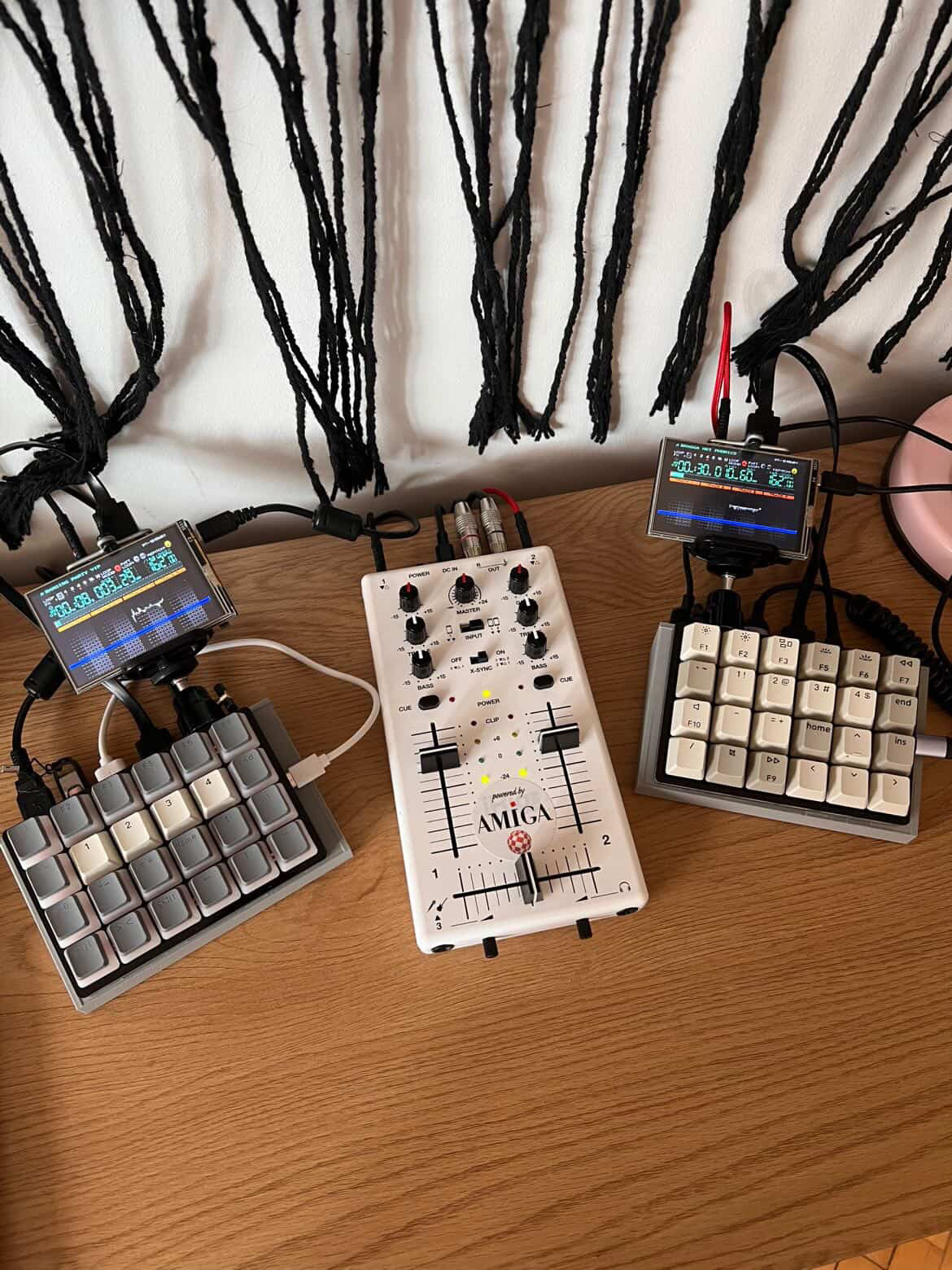 This is the super portable setup that XCOPY build for our mini-tour, crazy!
> STC: Why 2 Amigas and not one single Tracker? Do you like the "dj attitude" of mixing your own tracks? Do you provide any syncronizazion feature between them (audio midi-clock..)
> XCOPY: No, there’s no cable synchronization at all. Everything is done manually, you trigger, adjust, and correct things by hand in real time. It’s a very physical process.
The software I use, PT1210, is actually quite new, it dates from around 2014. So it’s not something from the original era, but a modern demoscene creation. Honestly, I can say that thanks to the PT1210 guys, my life changed a lot, really a lot.
> STC: Where your inspiration come from? Is there a particular artist that influenced your style?
> XCOPY: I truly love demoscene productions, and a huge part of my inspiration comes from people around me. Artists like XSM, Amiga Junglism, Si Goes Retro, Teo, cTrix, Juice, Randall, Celsius, h0ffman, Dascon, TZX, Magiel, Lynn Drumm, Subi, DJ Nest, Mygg, Zenial, Skope, Qwan, Stekker, Jazzcat, Jammer, KK and also friends like Tomarkus, Kalosz, Pator, Aceman, Dalthon, E!ghtBM, Dokthor, Dan, and 2G1B, and many others.
I really recommend checking out their work, not only modules but also productions on other platforms. It’s not just about MOD files, there’s also amazing stuff made with Adlib Tracker or on ZX Spectrum. For example, Pator’s ZX Spectrum tracks are pure gold, no doubt about it.
That whole ecosystem is a constant source of inspiration for me.
> STC: Do you find aesthetic or style matters in your hardware limits? And what are your pros & cons of having less evoluted trackers?
> XCOPY: I think it pushes me more toward composing with a sense of dramaturgy. Before, I used to just pour things in without much structure, but now every single pattern has meaning for me.
Those four channels are actually a perfect multiplier of creativity, that’s enough. It’s really satisfying when everything has to be carefully thought through. You don’t get lost in your own creation that way.
> STC: What's your relationship with the underground scene in Poland?
> XCOPY: As I mentioned before, I ran my own label for about 10 years, and I was involved in a few different bands and projects. I played a lot of shows in cities like Kraków, Warsaw, Białystok, Toruń, Bydgoszcz, Szczecin, Gdańsk, and many others.
For some time I was also active in the improvisational music scene, and as you know, that’s a space where you really connect with people through playing together. That network just kept growing naturally over time.
Right now, I’m deeply into the demoscene, and it feels like another chapter of the same journey. These kinds of niches are incredibly inspiring to me, they’ve given me a lot. I’ve met amazing people and had a great time along the way.
> STC: Tell us a bit more about "PTWeekender Crew"?
> XCOPY: In short, PT Weekender (previously PT1210 Weekender) is a non-profit online event where a group of DJs perform using two Commodore Amigas, mixing .mod tracker music, mostly dance-oriented, for both Amiga fans and music lovers.
It all started with XSM, Amiga Junglism, and Si Goes Retro, they were really the core of the crew. Then things began to grow. The first PT Weekender happened, and I joined during the second edition and stayed ever since. Now we’re heading toward the tenth edition.
It all began during the pandemic, and somehow it just kept going. It turned into a strong passion project and a really vibrant micro-community, with new DJs joining over time and sometimes old ones coming back as well.
On our server, we share samples, a lot of our own productions, finished tracks, retracks, VIP versions, and just a huge amount of music in general. It’s impossible to mention everyone involved, but I’ll try to highlight some of the key players, and apologies in advance if I miss anyone.
From the DJ core: !cyke, DJ NEST, DJ Nicci Dee, Amiga Junglism, breakbob, cTrix, Ghaleon, Tytus, h0ffman, Quaad, Si Goes Retro, Snakebyte64, Stekker, Teo, RAV, and last but not least, in my opinion absolutely crucial to building this community, the unstoppable and brilliant Xtra Spice Mikey.
> STC: Is there any micromusic/chiptune environment in Poland?
> XCOPY: I think that apart from the demoscene, which is very strong in Poland, there isn’t that much to find. If you look at people like Pator and other chiptune artists, there are definitely some great individuals, but as a wider scene, it’s quite limited.
There are projects like Mikro Orchestra (LSDJ crew) from friends in Wrocław, and a few smaller ones like Green Jesus, but overall there are really not many club events happening. Some people try to organize things in Warsaw, and Tytus made some efforts in Wrocław as well.
But somehow, this culture feels like it’s slipping away a bit in Poland, it’s not fully disappearing, but it’s becoming more and more elusive.
> STC: Is this your first tour outside Poland? Tell us about your next trip in Japan.
> XCOPY: No, not at all, I’ve already done quite a few tours around Europe. I’ve played in countries like Spain, France, Lithuania, Latvia, and Germany. I’ve also performed many times in Ukraine, since it’s quite close, with different projects, including as XCOPY.
As for Japan, I’m going there for an artistic residency with my girlfriend. We’ll be working on a field recording project called “Conversations with Fuji.” It’s a kind of performative piece, and at the same time we’re creating a larger body of documentation around it, including a book and a documentary film.
The whole project explores animistic and philosophical ideas through sound and performance.
> STC: Your tracks and livesets range from House to DNB, from Hardtechno to Jungle; We suppose it's a personal to be versatile, but what's your favourite direction in all these styles?
> XCOPY: That’s a really good question, because it actually changes a lot for me. It depends on the moment.
Right now, I feel like I’d really like to explore more experimental electronic music, something more searching and abstract. I kind of miss that aesthetic in the demoscene, the kind of feeling you’d get from labels like Raster-Noton or Mille Plateaux.
I’m also really inspired by things like the Ukrainian label Kvitnu, which I highly recommend. And artists like Pan Sonic or Frank Bretschneider, that kind of sound is something I’d love to explore more in my sets at the moment.
> STC: Do you identify more with the definition of DJ or producer? Is your approach similar to a real tracks transcription? We still don't understand your way to compose. Is what you play a "new stuff" produced by you or is it "coverization"? Tell us about your playing/composing process.
> XCOPY: I think right now I identify more as a DJ, I mostly play tracks in my sets. But I’m also working on my own material, I have an album coming out soon with around 25 tracks that I’ve been developing since 2022. It’s a big milestone for me, and I’ll probably start mixing those tracks more into my sets.
Everything I do is based on sampling. I’ve been fascinated with magnetic tape for years, and I sample a lot of material from VHS tapes. That’s where my kind of crunchy, textured sound comes from.
So what I play is a mix, some of it is my own productions, some of it is other people’s tracks, but everything goes through my own way of selection and live mixing. It’s not really about covering tracks, it’s more about reshaping and recontextualizing them in real time.
/////////////////////////
After we met
So, we wrote down this questions as we also don’t know what would be stay togheter for a week. A total black box.
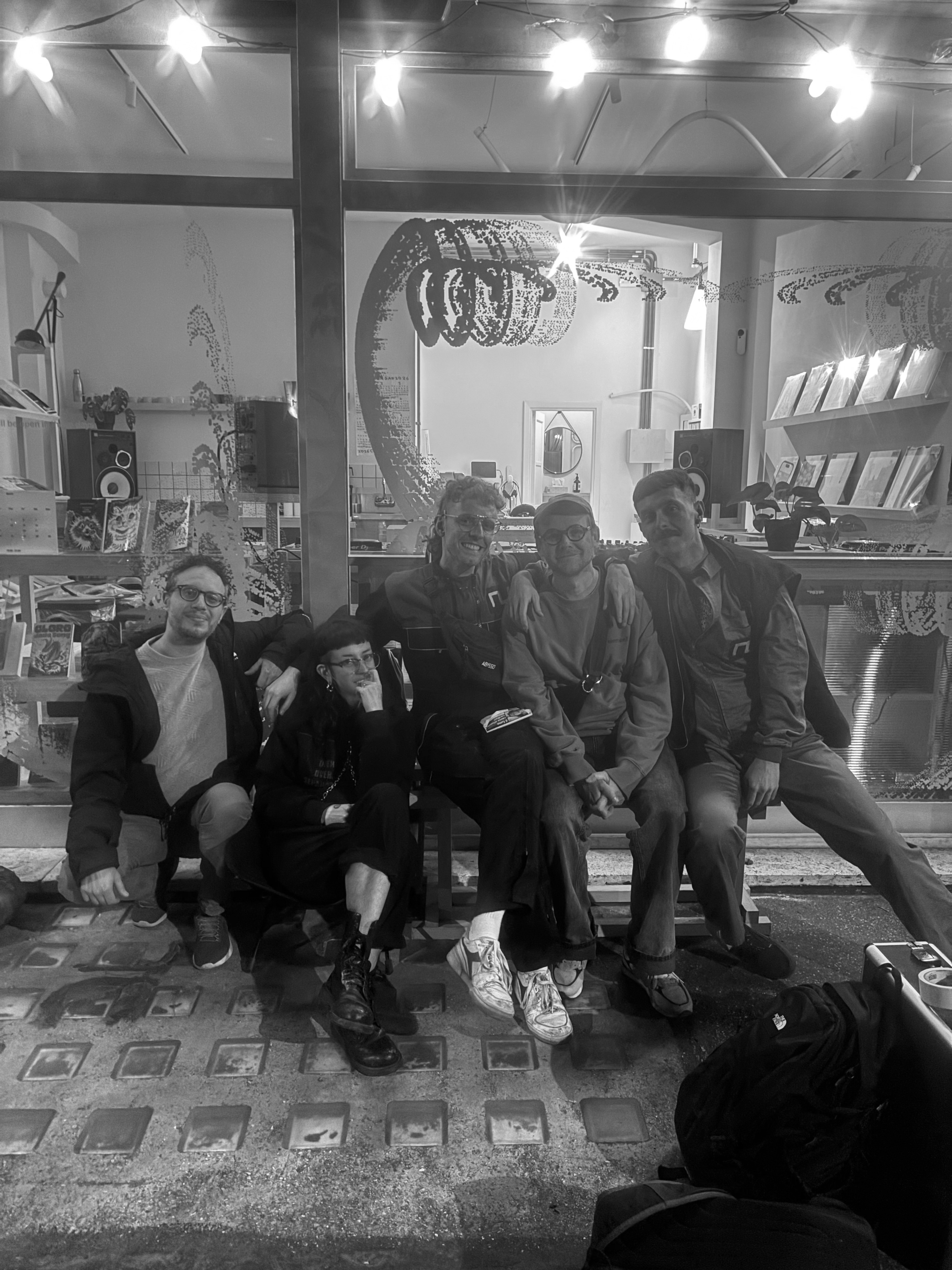 From left to right: KriSh, Artemisia666, Ick_ , XCOPY, b00leant_ (from our last day in Rome at Rhizome)
/////////////////////////
> STC: So, how are you after these days spent together?
> XCOPYPRO: I felt like I was among very good friends. I could really absorb everything, the music, the beautiful warm days, and the traveling. There were lots of conversations, a lot of openness, shared thoughts and ideas, and many similarities between us.
> STC: What was your best tour date? Naples/Itri/Rome?
> XCOPYPRO: All three shows were unique, but I think we’ll remember Itri the most. I played there for about six hours in total. I started with a jungle warm-up, then played techno in the middle of the night from around 2 to 3:30, and later in the morning I did a b2b set with Fabio on his soundsystem for another couple of hours. I met some amazing people there, had great conversations, shared stories around the fire, and really felt the atmosphere of the place. As Stefano called it, “agrotechno.”
> STC: Best fun facts that you remember about this tour?
> XCOPYPRO: I really loved the moment when the whole STC crew was singing “Tutto il resto è noia” by Franco Califano at the top of their lungs in the car on the way to Naples. That was unforgettable. That song has been with me for the past few days back in Poland, I keep listening to it on my headphones. It brings back strong emotions and takes me right back to that moment. Beautiful experience.
> STC: Sad to say but it's time to say goodbye! But we should say "Questo non è un addio, è un arrivederci!"
> XCOPYPRO: Sono sicuro di aver trovato nuovi amici in Italia, ed è questo che porto con me da questo viaggio. Grazie di tutto, vi voglio bene!
Grazie davvero, è stata un’intervista super! Le domande sono state tra le migliori e più azzeccate che abbia mai ricevuto. Davvero, grazie di cuore!
/////////////////////////
Finalmente ce l’abbiamo fatta! Dopo diversi tentativi, siamo finalmente riusciti a prenotare un mini-tour con questo artista pazzo, PAZZISSIMO, da Poznań, Polonia.
XCopyPro è un produttore, un Dj di Amiga Commodore che negli ultimi 6 anni ha cercato di portare l’esperienza ProTracker a un livello completamente diverso.
Prima del nostro incontro
/////////////////////////
> STC: Ciao!
> XCOPY: Ciao! Grazie mille per l’invito, è un vero piacere ;)
> STC: Come è iniziato tutto? Come ti sei avvicinato alla micromusica? Eri un fan/ascoltatore prima di esibirti?
> XCOPY: Ho iniziato piuttosto tardi con la scena Amiga. Il mio primo live set è stato nel 2020. Prima di allora, realizzavo collage sonori ed ero già profondamente interessato alla scena underground lowbit. Pubblicavo anche musica su floppy disk tramite la mia etichetta, Pionierska Records. Insieme al mio amico Zenial della demoscene polacca, che faceva parte della vecchia generazione dello swapping, abbiamo pubblicato alcune produzioni in stile demoscene classico.
È così che è iniziato il mio viaggio con la demoscene e la musica Amiga. Prima di allora, ho sperimentato con la creazione di musica su calcolatrici e ho fatto qualcosa sul Game Boy, ma l'ho abbandonato abbastanza presto a favore di ProTracker su Amiga. Mi sembrava semplicemente più affine. Le mie radici affondano nella cultura Atari e Amiga degli anni '90.
> STC: Quali sono le specifiche hardware/software e perché le hai scelte? Le hai modificate nel corso degli anni?
> XCOPY: All'inizio volevo essere molto purista e fedele all'hardware originale, per questo ho comprato un altro Amiga e mi sono impegnato al massimo per ottenere risultati con quella configurazione. Ma col tempo ho capito che bisogna evolversi, soprattutto in termini di mobilità e praticità. Queste macchine sono molto delicate ora, anche gli Amiga ben tenuti non gradiscono i viaggi continui. E dato che non sono una persona ricca, ho dovuto ripensare a come viaggiare in modo efficiente.
Viaggio principalmente in treno o in autobus e cerco di ridurre al minimo tutto, quindi ho iniziato a lavorare sulla configurazione più piccola possibile che mantenesse lo stesso flusso di lavoro. Ho provato soluzioni come Raspberry Pi, ma non hanno funzionato a causa di problemi di latenza.
La vera svolta è arrivata quando ho preso l'Amiga 500 Mini e l'ho adattato alle mie esigenze, costruendo la mia postazione attorno ad esso, progettando e stampando in 3D un case personalizzato e usando piccoli schermi da 3,5 pollici. Ha funzionato alla perfezione (un grande grazie a Janek per la stampa).
Ora sono completamente mobile e persino volare con compagnie low cost con solo bagaglio a mano non è più un problema per me.
> STC: Ci sono altri strumenti musicali oltre all'Amiga? Sei nato musicista elettronico?
> XCOPY: In passato ho registrato molto su cassette. A un certo punto facevo anche DJ set con cassette sotto il nome di Dolby, mixando e suonando usando le cassette. Viaggiavo molto e suonavo dal vivo in quel periodo, e le cassette sono diventate il mio primo vero amore.
In parte era anche una questione pratica, non avevo molti soldi e le cassette erano il supporto più economico disponibile. Ma questa limitazione conferiva loro una sorta di energia punk, che mi si addiceva perfettamente. In realtà ho iniziato nella scena punk, suonando in diverse band, quindi tutto si è evoluto in modo abbastanza naturale e ha iniziato a fondersi.
Quindi no, non sono "nato" musicista elettronico. È stata più una graduale evoluzione, dal punk, ai nastri, alle macchine.
This is the super portable setup that XCOPY build for our mini-tour, crazy!
_Questa è la configurazione super portatile che XCOPY ha creato per il nostro mini-tour, *pazzesca*!_
```intervista
> STC: Perché due Amiga e non un singolo Tracker? Ti piace l'approccio da DJ di mixare le tue tracce? Utilizzi qualche funzione di sincronizzazione tra di loro (audio, MIDI, clock...)?
> XCOPY: No, non c'è alcuna sincronizzazione via cavo. Tutto viene fatto manualmente, si attivano, si regolano e si correggono le cose a mano in tempo reale. È un processo molto fisico.
Il software che uso, PT1210, è in realtà piuttosto recente, risale al 2014 circa. Quindi non è qualcosa dell'epoca originale, ma una creazione moderna della demoscene. Onestamente, posso dire che grazie ai ragazzi di PT1210 la mia vita è cambiata molto, davvero molto.
> STC: Da dove trai ispirazione? C'è un artista in particolare che ha influenzato il tuo stile?
> XCOPY: Amo davvero le produzioni della demoscene e gran parte della mia ispirazione proviene dalle persone che mi circondano. Artisti come XSM, Amiga Junglism, Si Goes Retro, Teo, cTrix, Juice, Randall, Celsius, h0ffman, Dascon, TZX, Magiel, Lynn Drumm, Subi, DJ Nest, Mygg, Zenial, Skope, Qwan, Stekker, Jazzcat, Jammer, KK e anche amici come Tomarkus, Kalosz, Pator, Aceman, Dalthon, E!ghtBM, Dokthor, Dan e 2G1B, e molti altri.
Consiglio vivamente di dare un'occhiata ai loro lavori, non solo ai moduli ma anche alle produzioni su altre piattaforme. Non si tratta solo di file MOD, ci sono anche cose incredibili realizzate con Adlib Tracker o su ZX Spectrum. Ad esempio, le tracce di Pator per ZX Spectrum sono oro puro, senza dubbio.
Tutto quell'ecosistema è per me una fonte costante di ispirazione.
> STC: Ritieni che l'estetica o lo stile siano importanti nei limiti del tuo hardware? E quali sono i pro e i contro di avere tracker meno evoluti?
> XCOPY: Penso che mi spinga maggiormente a comporre con un senso di drammaturgia. Prima, mi limitavo a riversare elementi senza molta struttura, ma ora ogni singolo pattern ha un significato per me.
Quei quattro canali sono in realtà un perfetto moltiplicatore di creatività, e questo è sufficiente. È davvero appagante quando tutto deve essere attentamente ponderato. In questo modo non ci si perde nella propria creazione.
> STC: Qual è il tuo rapporto con la scena underground in Polonia?
> XCOPY: Come ho già detto, ho gestito la mia etichetta discografica per circa 10 anni e sono stato coinvolto in diverse band e progetti. Ho suonato in molti concerti in città come Cracovia, Varsavia, Białystok, Toruń, Bydgoszcz, Stettino, Danzica e molte altre.
Per un certo periodo sono stato attivo anche nella scena della musica improvvisata e, come sai, è un ambiente in cui si crea un vero legame con le persone suonando insieme. Questa rete di contatti è cresciuta naturalmente nel tempo.
Ora sono immerso nella demoscene e la considero un altro capitolo dello stesso percorso. Queste nicchie sono incredibilmente stimolanti per me, mi hanno dato molto. Ho incontrato persone fantastiche e mi sono divertito un mondo.
> STC: Parlaci un po' di più della "PTWeekender Crew"?
> XCOPY: In breve, PT Weekender (precedentemente PT1210 Weekender) è un evento online senza scopo di lucro in cui un gruppo di DJ si esibisce utilizzando due Commodore Amiga, mixando musica tracker .mod, principalmente orientata alla dance, per appassionati di Amiga e amanti della musica.
Tutto è iniziato con XSM, Amiga Junglism e Si Goes Retro, che costituivano il nucleo del gruppo. Poi le cose hanno iniziato a crescere. Si è tenuto il primo PT Weekender e io mi sono unito durante la seconda edizione, rimanendoci da allora. Ora ci stiamo avvicinando alla decima edizione.
Tutto è iniziato durante la pandemia e in qualche modo è continuato. Si è trasformato in un progetto nato dalla passione e in una micro-comunità davvero vivace, con nuovi DJ che si sono uniti nel tempo e a volte anche vecchi DJ che sono tornati.
Sul nostro server condividiamo sample, molte delle nostre produzioni, brani completi, retrack, versioni VIP e in generale una grande quantità di musica. È impossibile menzionare tutti i coinvolti, ma cercherò di evidenziare alcuni dei protagonisti principali, e mi scuso in anticipo se dovessi dimenticare qualcuno.
Dal nucleo centrale dei DJ: !cyke, DJ NEST, DJ Nicci Dee, Amiga Junglism, breakbob, cTrix, Ghaleon, Tytus, h0ffman, Quaad, Si Goes Retro, Snakebyte64, Stekker, Teo, RAV e, ultimo ma non meno importante, a mio parere assolutamente cruciale per la costruzione di questa community, l'inarrestabile e brillante Xtra Spice Mikey.
> STC: Esiste un ambiente micromusicale/chiptune in Polonia?
> XCOPY: Credo che a parte la demoscene, che è molto forte in Polonia, non ci sia molto altro da trovare. Se si guardano artisti come Pator e altri artisti chiptune, ci sono sicuramente degli ottimi individui, ma come scena più ampia, è piuttosto limitata.
Esistono progetti come Mikro Orchestra (crew LSDJ) di amici di Breslavia, e alcuni più piccoli come Green Jesus, ma nel complesso non ci sono molti eventi nei club. Alcuni cercano di organizzarne a Varsavia, e anche Tytus ha fatto qualche tentativo a Breslavia.
Tuttavia, in qualche modo, questa cultura sembra stia svanendo un po' in Polonia, non sta scomparendo del tutto, ma sta diventando sempre più difficile da trovare.
> STC: È il tuo primo tour fuori dalla Polonia? Parlaci del tuo prossimo viaggio in Giappone.
> XCOPY: No, assolutamente no, ho già fatto diversi tour in Europa. Ho suonato in paesi come Spagna, Francia, Lituania, Lettonia e Germania. Mi sono esibito anche molte volte in Ucraina, dato che è abbastanza vicina, con diversi progetti, incluso quello di XCOPY.
Per quanto riguarda il Giappone, ci andrò per una residenza artistica con la mia ragazza. Lavoreremo a un progetto di registrazione sul campo chiamato "Conversations with Fuji". È una sorta di performance, e allo stesso tempo stiamo creando un corpus di documentazione più ampio, che include un libro e un film documentario.
L'intero progetto esplora idee animistiche e filosofiche attraverso il suono e la performance.
> STC: I tuoi brani e i tuoi liveset spaziano dalla House alla DNB, dall'Hardtechno alla Jungle; supponiamo che la versatilità sia una tua caratteristica personale, ma qual è il tuo genere preferito in tutti questi stili?
> XCOPY: Ottima domanda, perché per me la risposta cambia molto. Dipende dal momento.
In questo momento, sento il desiderio di esplorare la musica elettronica sperimentale, qualcosa di più ricercato e astratto. Mi manca un po' quell'estetica della demoscene, quel tipo di atmosfera che si respirava con etichette come Raster-Noton o Mille Plateaux.
Sono anche molto ispirato da etichette come la ucraina Kvitnu, che consiglio vivamente. E artisti come Pan Sonic o Frank Bretschneider, quel tipo di sonorità è qualcosa che mi piacerebbe esplorare di più nei miei set in questo periodo.
> STC: Ti identifichi di più con la definizione di DJ o di produttore? Il tuo approccio è simile alla trascrizione di un brano reale? Non abbiamo ancora capito bene il tuo modo di comporre. Quello che suoni è "materiale nuovo" prodotto da te o è una "cover"? Parlaci del tuo processo di esecuzione/composizione.
> XCOPY: Credo che in questo momento mi identifichi di più come DJ, nei miei set suono principalmente brani già pronti. Ma sto anche lavorando al mio materiale, a breve uscirà un album con circa 25 tracce che sto sviluppando dal 2022. È un traguardo importante per me, e probabilmente inizierò a mixare più spesso quei brani nei miei set.
Tutto ciò che faccio si basa sul campionamento. Sono affascinato dai nastri magnetici da anni e campiono molto materiale dalle videocassette VHS. È da lì che deriva il mio suono un po' grintoso e ricco di texture.
Quindi quello che suono è un mix, in parte composto da mie produzioni, in parte da brani di altri, ma tutto passa attraverso il mio personale metodo di selezione e mixaggio dal vivo. Non si tratta tanto di fare cover, quanto piuttosto di rimodellare e ricontestualizzare i brani in tempo reale.
/////////////////////////
Dopo il nostro incontro
Quindi, abbiamo scritto queste domande perché anche noi non sapevamo cosa ci aspettasse stando insieme per una settimana. Una scatola nera totale.
Da sinistra a destra: KriSh, Artemisia666, Ick_ , XCOPY, b00leant_ (dal nostro ultimo giorno a Roma al Rhizome)
//////////////////////////
> STC: Allora, come vi sentite dopo questi giorni trascorsi insieme?
> XCOPYPRO: Mi sono sentito tra ottimi amici. Ho potuto assorbire tutto, la musica, le belle giornate calde e il viaggio. Ci sono state tante conversazioni, molta apertura, pensieri e idee condivise e molte somiglianze tra noi.
> STC: Qual è stata la data migliore del tuo tour? Napoli/Itri/Roma?
> XCOPYPRO: Tutti e tre gli show sono stati unici, ma credo che ricorderemo soprattutto Itri. Ho suonato lì per circa sei ore in totale. Ho iniziato con un riscaldamento jungle, poi ho suonato techno nel cuore della notte, dalle 2 alle 3:30 circa, e più tardi la mattina ho fatto un set b2b con Fabio sul suo soundsystem per un altro paio d'ore. Ho incontrato persone fantastiche, ho avuto delle belle conversazioni, ho condiviso storie intorno al fuoco e ho davvero sentito l'atmosfera del posto. Come l'ha definita Stefano, "agrotechno".
> STC: Quali sono gli aneddoti più divertenti che ricordi di questo tour?
> XCOPYPRO: Ho adorato il momento in cui tutta la crew di STC cantava a squarciagola "Tutto il resto è noia" di Franco Califano in macchina, mentre andavamo a Napoli. È stato indimenticabile. Quella canzone mi è rimasta impressa per diversi giorni, anche ora che sono tornato in Polonia, e continuo ad ascoltarla in cuffia. Mi fa rivivere emozioni forti e mi riporta indietro a quel momento. Bellissima esperienza.
> STC: Triste a dirsi ma è ora di salutarci! Ma dovremmo dire "Questo non è un addio, è un arrivederci!"
> XCOPYPRO: Sono sicuro di aver trovato nuovi amici in Italia, ed è questo che porto con me da questo viaggio. Grazie di tutto, vi voglio bene!
Grazie davvero, è stata un'intervista super! Le domande sono state tra le migliori e più azzeccate che abbia mai ricevuto. Davvero, grazie di cuore!
/////////////////////////